Pages

Sunday, 8 December 2013

Ghosts of the outskirts of Niš, Serbia

One sunny day, Niš.
Niš, a spacious town of 200 thousand by the river in southern Serbia, nowadays looks rather chilled - at least so in the centre. True, it is Serbia's third largest city and an important industrial hub - but downtown the life appears peaceful, with street cafes & shops and an old fortress.

The relaxed downtown, however, is surrounded from three sides by gloomy reminders of death and otherwise bloody history. On arrival to Niš I feel like a child talking to a pleasant, cultured lady. Polite and nicely dressed, she chats to me about pretty things and gives me sweet little presents but I can sense the deep fjord of cold between us; I know she hides something from me that is behind my capacity to understand. Then I discover some frightening things in her closets.

Serbian history, like the history of the Balkans in general, has witnessed no shortage of blood and head chopping, literally.

GHOST OF THE NORTH is the Nazi concentration camp of the Red Cross, a.k.a the camp of 12 February. The latter name was given to the camp not by the Nazis - on 12 February 1942 over a hundred of the camp's prisoners managed to escape behind the guarded double-wire fence. It was the biggest to date escape from a Nazi camp. After the escape the Red Cross was reinforced with concrete walls, and the subsequent escape at the end of the same year was much less successful.

Red Cross is rather compact in scale (when you compare it to e.g. Auschwitz) but it could hold a few hundred people at a time on the two floors of the large barn style building - ground floor for men, first floor for women and children. It remains today as one of the best preserved Nazi camps in Europe.

The Red Cross was built as a detention camp for the local Jews, Roma, Serbians. Mass killings did not happen there, instead, the victims were either brought by trains to other, larger, concentration camps, or mass-shot at the local Bubanj area which is the city's GHOST OF THE SOUTHWEST.

Nowadays Bubanj park is a recreational area but the massive sculptures of three clenched fists symbolysing men, women and children shot here remind everyone about the area's past.

GHOST OF THE EAST, Chele Kula, is where the major road to Istanbul during the Ottoman times used to be. Big part of Serbia was conquered by the Ottomans. In 1809 a battle between Serbian rebels and the Ottoman army took place in the neighbourhood - it was part of the broader uprising against the empire. The battle ended tragically for the Serbs, and, in order to demonstrate their power and to give fear to any potential future resistants, the Ottomans built on the said major road a tall tower, studded from all its sides, floor to top, with the defeated Serbians' skulls.

It has been calculated that nearly a thousand of skulls were used for the construction. Nowadays are remaining only 58 of them - the rest were burried or stolen by souvenir hunters and otherwise disappeared during the time. The tower, now locked inside a chapel, for over eighty years stood completely uncovered.

The skull tower was not the only such type of construction made by the Ottomans but it is certainly one of the best known and one of the most symbolic. Many Serbians will point it out to you as a must see during your visit; it means much to them.
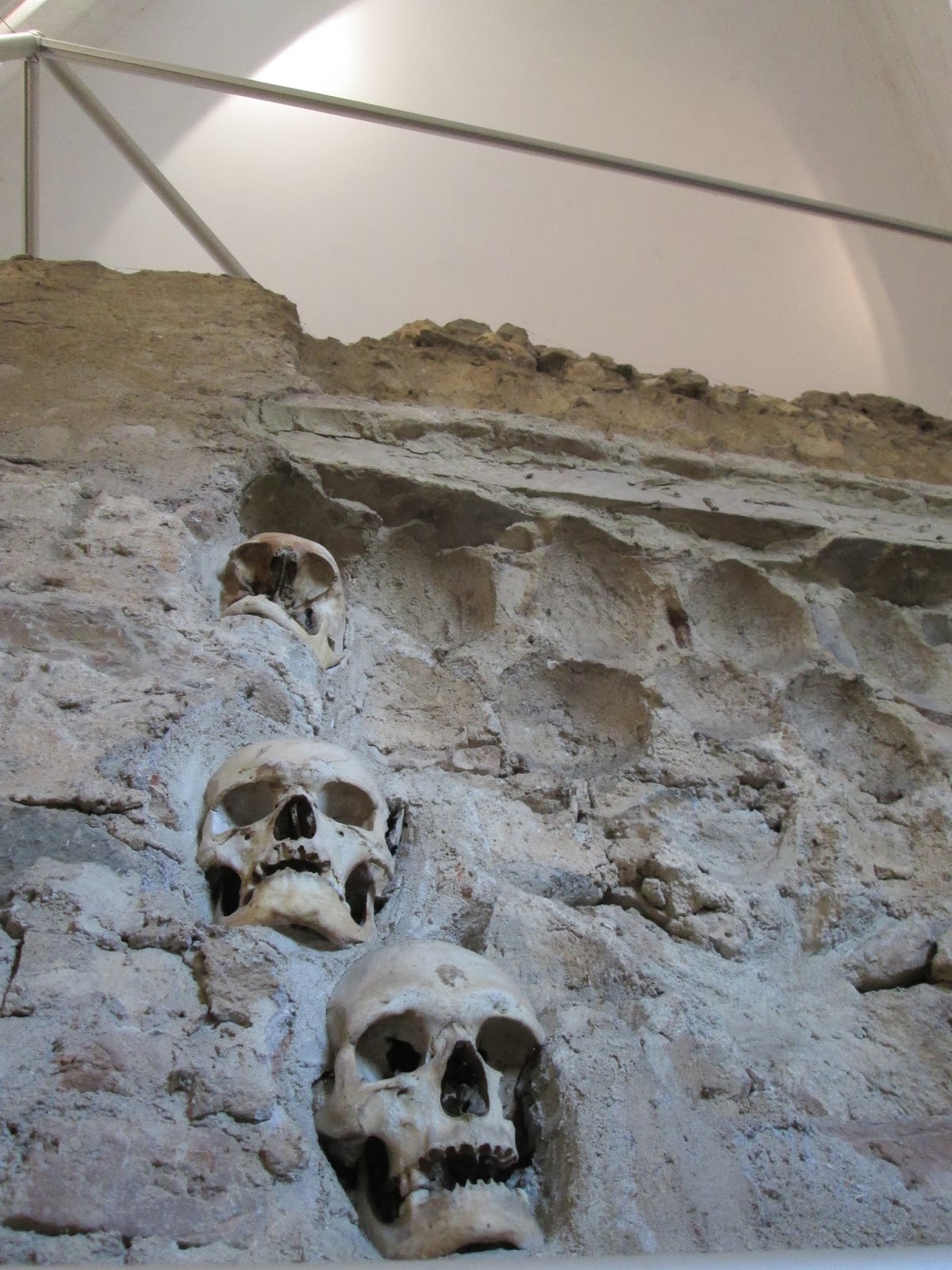

Some of the remaining skulls, Chele Kula.
Text and photos (c) Agne Drumelyte, 2013.

Saturday, 7 December 2013

Autumn outfits of Lake Pancharevo

This post is a few weeks overdue.

One mid-November day I was walking around Lake Pancharevo with my camera on and I captured some of its autumn specialities.

Now Sofia is leaf-less and parts of it are covered with snow. Let us go back to the recent colourful times for a few minutes.


The rowers are still there.


Text and photos (c) Agne Drumelyte, 2013.

Harry Benson in Sofia - your chance to see the contemporary photography classics

Harry Benson giving a speech during the opening of his '60 Years in Photographs' exhibition, 5 December 2013, Sofia. 

An exhibition of over forty works by the legendary Scottish American photographer Harry Benson can now be seen at the Vivacom Art Hall in Sofia. The show marks the 60 years' anniversary of Benson as a professional photographer.    

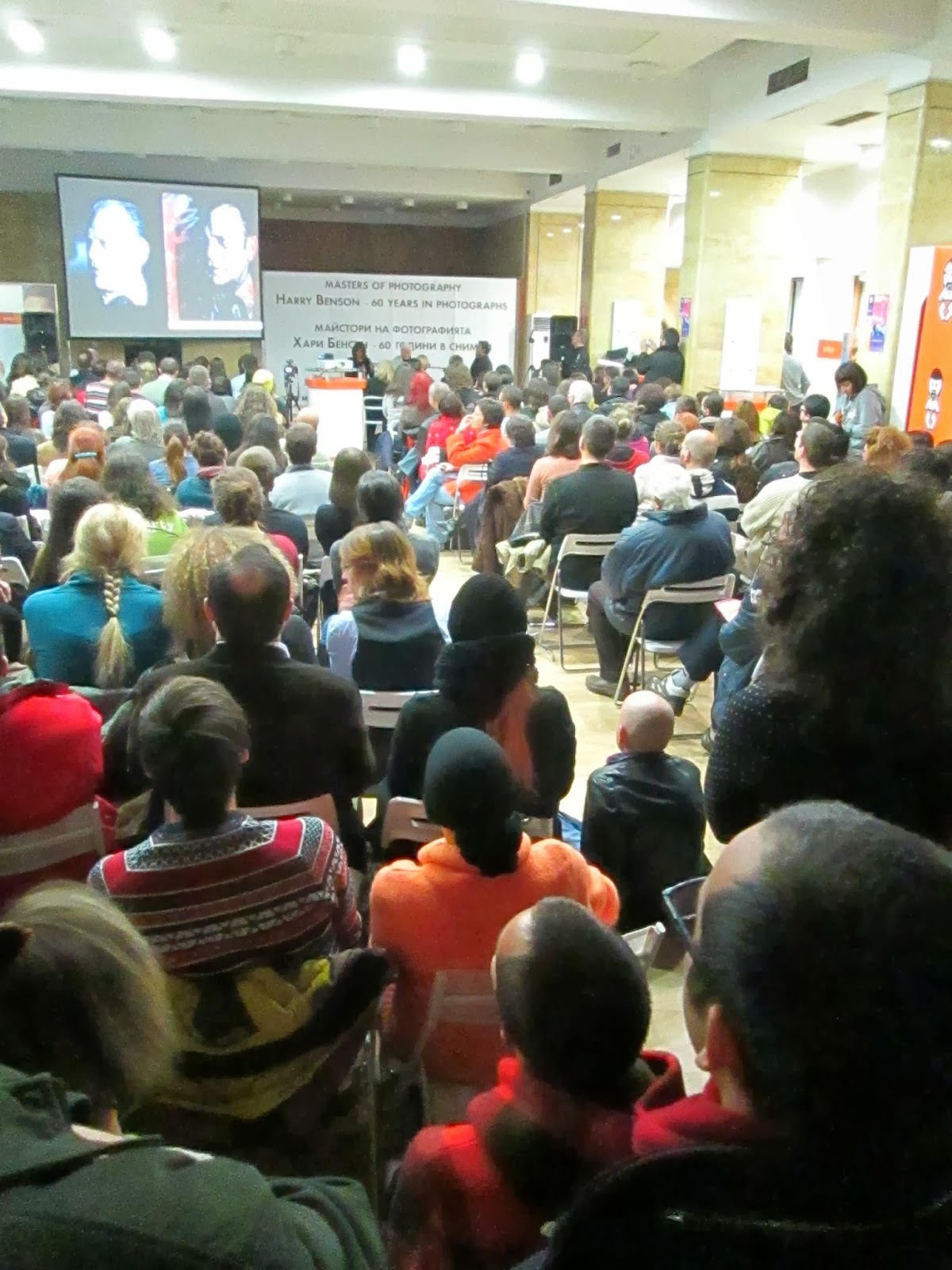
Mr Benson himself attended the opening event of the exhibition on 5 December. The next day he gave a public lecture during which he demonstrated yet more photographs and told the stories behind them. The lecture room was completely packed. Queues of people were waiting to get his autographs after the talk.

Now in his 80s, Harry Benson retains a noticeably youthful aura around him, along with sharp wit and wisdom - without too many unnecessary words. His sentences are elegant and a delight to follow, and, despite all the years spent living in the USA, mild Glaswegian accent can still be heard in his voice.

Benson is often mentioned as a long-term photographer for the Life magazine. His career has been very diverse. After publishing his very first photo of a deer from his father's zoo in Glasgow, Benson went on to photograph weddings, then he was hired as a reporter to cover all Scotland, then got an assignment to follow The Beatles on tour, then he followed them to America and decided to stay. A career at Life followed.

Benson has photographed many famous people including all American presidents, starting with Eisenhower, as well as many actors, musicians & other stars. However, his portfolio also includes a significant share of photographs from the rougher side of life: the racial clashes of the 1960s, the Ku Klux Klan, the IRA, the war in the Dominican Republic. He has captured the assasination of Robert F. Kennedy in 1968. Benson is often informally titled as the chronicler of the 1960s.    

It's great to be able to see works of such a legend in Sofia - you have time until 15 January 2014.


Crowded room during the lecture, 6 December.
Text and photos (c) Agne Drumelyte, 2013.

Monday, 2 December 2013

Bulgarian anti-government demonstrations: revolution, evolution, or just a street party

Bulgarian demonstrators asking for the EU help in getting rid of their government. November 2013.

From a distance it sounds like a football match: the pulsating noise of chants, vuvuzelas and whistles. Approaching closer, you start to register separate phrases being shouted out by the crowds: Ma-fi-ja! - Os-tav-ka! - Cher-ve-ni pod-klu-tzi! Then you see them.

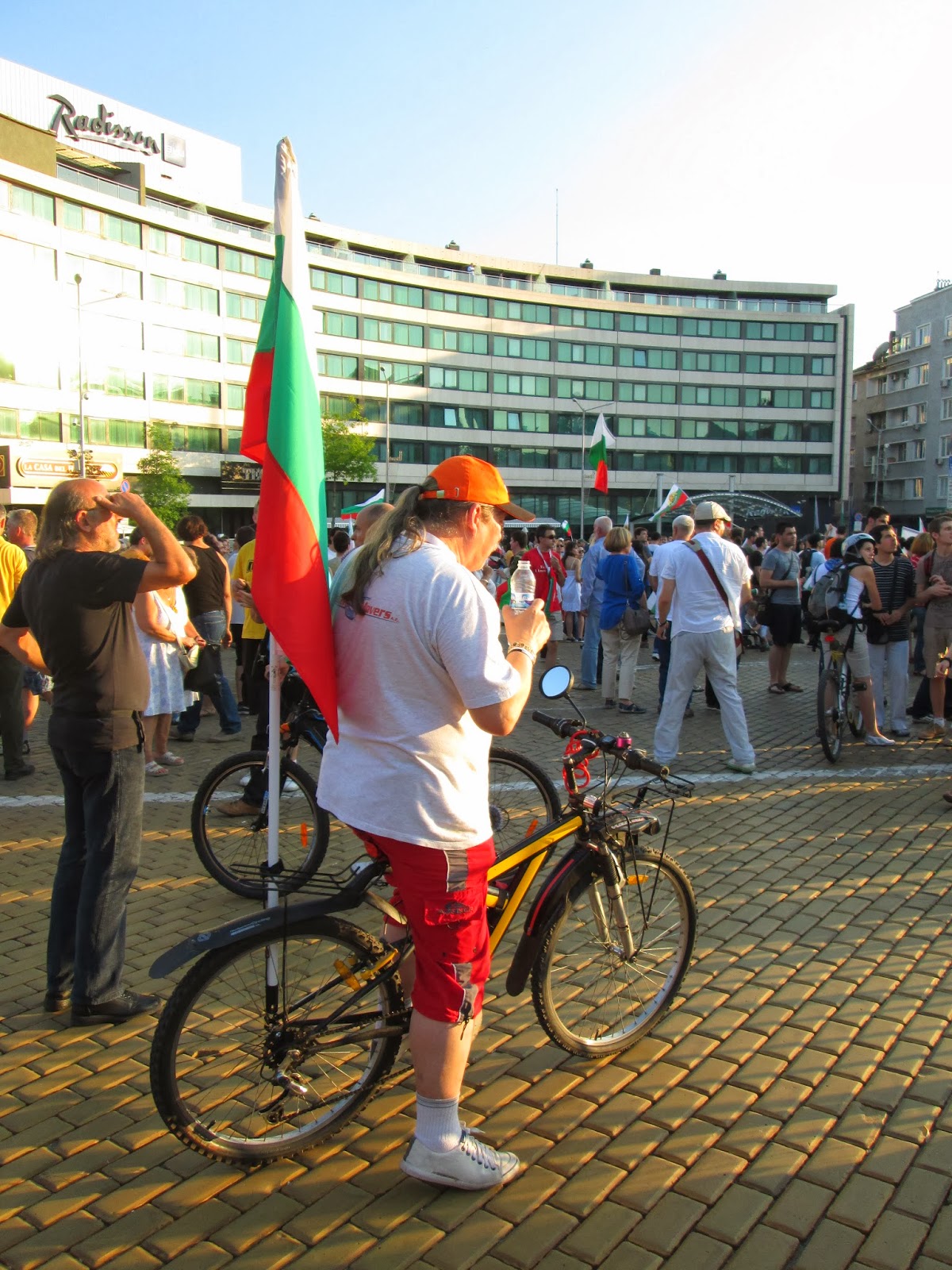
Hundreds, on some days thousands of demonstrators: carrying Bulgarian flags or wrapped in them; walking, marching and cycling; people with small children in prams and the elderly; dog walkers and those straight from the office; serious-looking citizens and guys with plastic two-litre beer bottles.

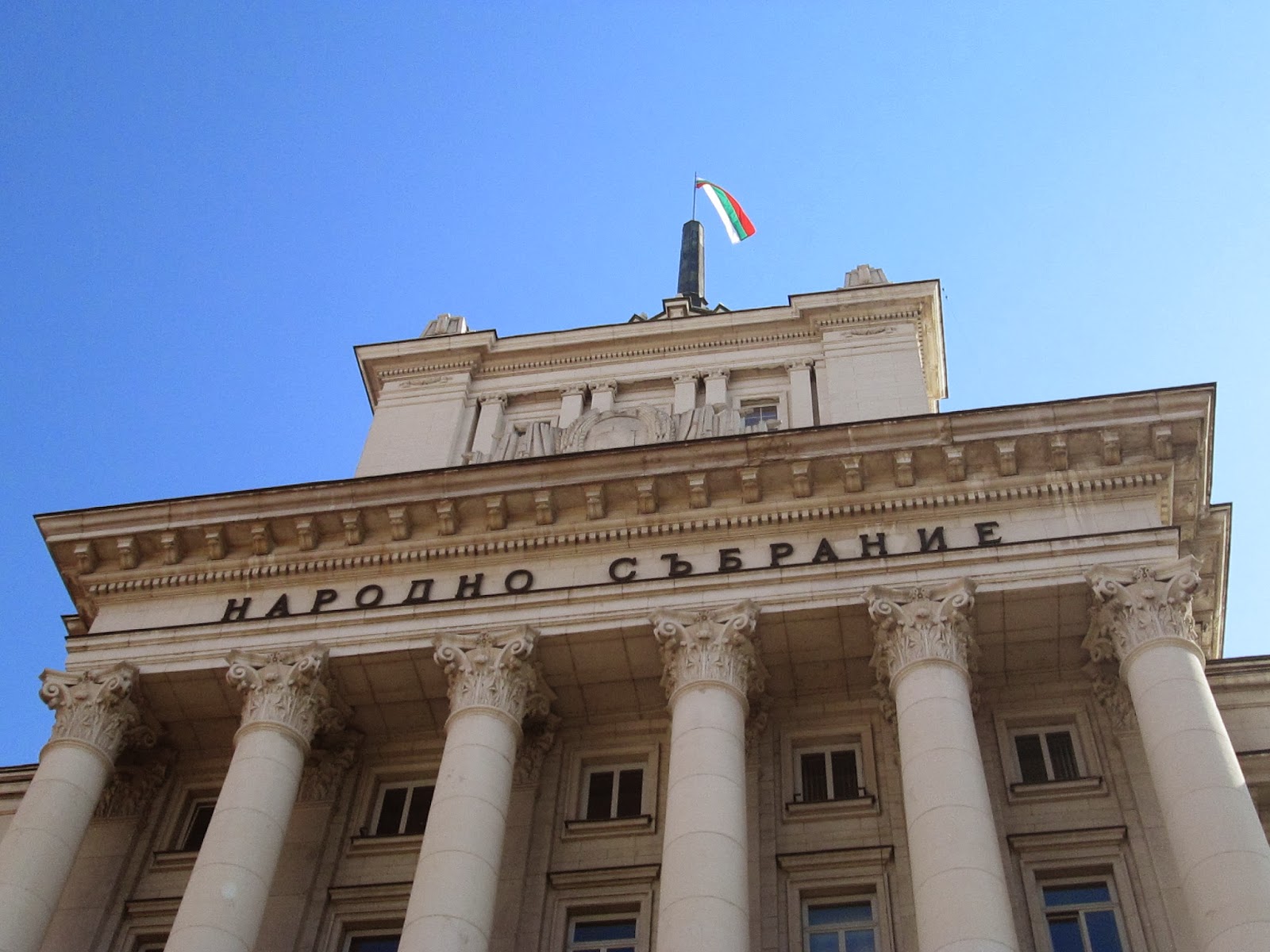
Every day they meet at the Largo, demonstrate there, then march along the Tsar Osvoboditel Boulevard, stop at the Parliament, then continue towards the Sofia University and beyond. Some live in tents in the proximity of the Parliament building. The monument of the Osvoboditel (Liberator) himself, sitting tall on a horse opposite the Parliament entrance, is covered up to the hooves with banners, slogans and perching demonstrators.

For some the demonstrations are a type of social gathering, a street party where new friends are made and romances start; for others it is a very serious business. Some of my colleagues dilligently go there every day after work. I have seen groups demonstrating in front of the German embassy - asking for the Germans' help in removing the corrupted Bulgarian government.

The police fence the access to the main government buildings and close certain streets every afternoon in preparations; TV crews park their vans and wait for that night's spectacle. For journalists, being and working there does not necessarilly mean that their reports will be broadcasted, as much of the media is said to be ruled by the same governing clan.

My relatives abroad find out about the demonstrations months after they have actually started - and I have been witnessing them every single day since the early June. Only in August, the holliday month, the parades had diminished for a couple of weeks in Sofia - but even then there had been some outbursts on the Bulgarian seaside, including one at a beach campsitte. In September Sofian troops were firmly back in the streets of the capital once again.

I have seen masses of people chanting while riding the metro; quiet commuting pensioners with their Bulgarian flags carefully rolled away, dogs dressed in slogan-bearing dog vests. I have felt an air of upheaval and solidarity. The sheer amounts of the demonstrators, especially during the early summer days, were those comparable to only what I had seen as a child back in Vilnius during the Lithuanian 'Singing Revolution'. 

The Bulgarian 'singing revolution', however, was not meant to take over. People are still demonstrating and the same government is still on. Nothing has changed.

When asked who might be a better replacement for the government still in power a few Bulgarians simply do not seem to know any alternatives. 'No political culture here, everyone is corrupted', one of them says.

Then a watching youngish foreigner from Wester Europe thoughtfully suggests the demonstrators set up a party and pick the new leaders from among themselves. 

Below are some images from various days of the demonstration.


 Text and photos (c) Agne Drumelyte, 2013.

Friday, 25 October 2013

Party House, NOT a nightclub

A big red star used to be where now the Bulgarian flag is. Top of the Party House.

Much of what I am telling you here in this post is what I have learned during a pilot tour* to the Largo. The complex allegedly was designed by the best Bulgarian architects of the time, with the supervision by the soviets, and it drew inspiration from the Bulgarian medieval past (see the shapes of the lamps and the arches inside). It just so happened that the architects were trained during the pre-communist era.  

The Party House imitates classicist palaces (Roman/Italian, French) - note the columns; the round foyer & ceiling; the straight axis design. Simultaneously, the building includes decorative elements depicting the fruits and products of the Bulgarian countryside: clusters of grapes, roses, wheat ears, so it brings the palace closer to farmers & proletarians - the 'right' communist folks. Details are a very important element of this building.  

The House was constructed of local, Bulgarian, staples, with the exception of Bohemian glass chandelliers, the material for which was brough over from Czechoslovakia. (The only original chandeliers still in use nowadays can be found at the nearby Hotel Sheraton). 

 *If all goes well, the tour should be up and running from approximately November 2013 - check for the updates here. The tour is part of the Southeastern-Europe-wide ATRIUM project. 

- - - -

After the fail of socialism in the 1990s the Largo buildings remained more or less the same, apart from the fact that the hammers-and-sickles were dutifully removed from the decorative ornamentations, as well as the big red star from the top of the Party House. No more Lenins, Stalins and similar figures can be found at the Largo today - if you are feeling nostalgic you can go and see some of them (as well as the said red star) at the Museum of the Socialist Art. Plus, the Mausoleum of Georgi Dimitrov, the former socialist leader, dissapeared from the face of the earth.  

- - - -

Now time for some images:

Hammer and sickle removed.
The round ceiling & chandellier.
Decorative elements.
Columns.
Ceiling, the main hall.
Corridor (there are 3 kms of them in the building).
Balconies, with grape clusters & roses.
Hammer & sickle removed.
Text and photos (c) Agne Drumelyte, 2013.

Largo, the scary (not anymore) Triangle of power will open up to the public

The Largo at night. (c) Agne Drumelyte.

Right in the center of Sofia, above where the main street of the ancient city of Serdika was, looms the strict, monumental architectural complex The Largo - one of the more known socialist architecture examples in Eastern Europe.  

It was built in the early 1950s, in the lands freshly-flattened by the WW2 bombings (as much as 1/4 of the city was destroyed beyond repair then - especially the center).  

Rather oversized for the under 7.5 million Bulgarian population, the Largo consisted of functionnaire buildings: Ministries of Electrification & Heavy Industry; the Government; the Party House - that is, the house of the Communist Party, not a nightclub.

It also included attractions like the former leader's Georgi Dimitrov's mausoleum (1949; constructed in only six days as the great Bulgarian socialist leader died unexpectedly during his visit to Moscow); and the TZUM, at the time Bulgaria's most prestigious department store where the products of the socialist workers' achievements were on display for local and international visitors.

The important guests used to stay at the nearby Hotel Balkan, also part of the complex - the building nowadays is used by Hotel Sheraton.  

All of the said buildings, except for the mausoleum that was demolished in the 1999, still dominate the central Sofia today. Most of them, however (with the exceptions of the TZUM and the Hotel Sheraton) can be seen only from the outside. The former communist government buildings are used by the democratic Bulgarian government nowadays.     

There is, though, a hope that the great dinosaurs will open up to the public one day. I have just been on a trial tour to the complex, 'The [Un]Known Largo'*, and have witnessed some of the insides of the former communist Party House - see a post on it here.  

The tour is part of the EU-funded ATRIUM project that aims to create & promote a cultural tour route through the Southeastern Europe, one that is concerned with the totalitarian architecture of the 20th century. Most of the tour's venues are socialist buildings of the Balkans but a couple of right-wing totalitarian venues are on the list too. 

*If all goes well, the tour should be up and running from approximately November 2013 - check for the updates here. 

The facade of the Party House (centre), on the same night.

Text and photos (c) Agne Drumelyte, 2013.

Monday, 21 October 2013

Free mineral water: the springs at the Banya Bashi

For a while this was my favourite place in Sofia; also one to which I was taking all the newcomers to show it to them as one of the city's attractions. Although rough and scruffy, the Banya Bashi area is where one can observe the powers of nature at work: the thermal Mineral Springs.

There is no shortage of springs in Bulgaria. They come in all temperatures, flavours, scents and mineral compositions. In Sofia region alone mineral springs provide around 500 litres of water per second. There are several of them in Sofia; quite a famous medicinal one can be found next to Lake Pancharevo.

The springs next to Banya Bashi, however, are right in the centre of the city; and they are hot, robust and plentiful. The flowing water is organised into some thirty taps that run continuously day and night as if they were little fountains. The temperature of the water is perhaps enough to brew oneself a cup of tea with it.

The place is always full of people: drinking; washing their hands; filling up large plastic bottles to bring home. There are also homeless people washing themselves and doing their laundry. The city's pigeons and cats make sure they get their share too. The access to the water is open to everyone.

Right next to the springs there is a busy tram stop. So far, even in the middle of the night, I have not yet seen the place empty. I like to wait there during the more quiet times of the day; when one can hear the water running, and, if it's cold enough, see the steams. Even if the area is kept neither very clean nor too beautiful it has a surprisingly nice feel to it. It is not the most photogenic place in the world so my advice would be just to go and experience it.

These springs have been in use since at least the Roman times, perhaps even earlier. From the more recent times the roughly a hundred year old yellow building of Central Mineral Baths remains in the neighbourhood. The building used to be a public bathing place up until the late 1980s - it used the readily-warm water straight from the springs.

Today the house is gradually decomposing, although there are some plans to reanimate it and to make it a bathing place again (this time, though, within there would be a 'top notch spa' and a gallery). Noone is certain about how long the renovation is going to take but, as a foreigner, I can say that I would be one of their regular visitors.  


The former Central Mineral Baths' building, waiting for the renovation.

Text and photos (c) Agne Drumelyte, 2013.